Commercial Used Cooking Oil Containers: A Practical Guide for NYC Kitchens
The right container for your used cooking oil makes a bigger difference than most operators initially expect. It affects how safely your staff handles oil at the end of each shift, how your kitchen meets DEP compliance requirements, whether your outdoor storage attracts pests or creates odor issues, and how smoothly collection pickups run. And in New York City, where kitchens are often working with dramatically compressed footprints and service access constraints that don't exist in other markets, container selection is a genuine operational decision, not just an afterthought.
We've worked with food service operations across Manhattan, Brooklyn, and Queens for over 15 years, and the container questions we hear often are about sizing, placement, and what the DEP actually requires. By the end of this article, you'll have a clear sense of what type of container fits your operation, how to size it correctly, and what you need to do to stay fully compliant.
Why Container Choice Has Real Consequences
Used cooking oil doesn't stay neatly where you put it unless it's in the right vessel. Hot oil poured into an improperly rated plastic container can warp or fail. An undersized container overflows before the next scheduled pickup, creating spill risk, pest attraction, and a DEP compliance problem. A container placed in the wrong location creates an obstacle course for your staff during a busy closing shift or blocks a service vehicle from completing the collection cleanly.
There's also a chemistry reason to care about container quality. When hot or warm oil enters an improperly sealed container, condensation forms inside, introducing water into the stored oil. Water accelerates the hydrolysis breakdown process in cooking oil, degrading its quality and creating conditions that attract pests. A well-designed UCO container minimizes light and oxygen exposure, holds a proper seal, and is rated to handle the temperatures your oil will be at during transfer.
Understanding how proper storage conditions connect to the broader compliance requirements for used cooking oil in NYC is the right starting point for any operator setting up a container program for the first time or reviewing an existing one.
Indoor Containers: Options for Kitchens Without Direct Outdoor Access
Many commercial kitchens in NYC don't have convenient outdoor service access. For these operations, indoor containers are the practical solution, and there's a meaningful range of options depending on your volume and available square footage.
The most common indoor option for low-to-moderate volume kitchens is a wheeled polyethylene container, typically 55 gallon. These units are designed to be rolled from a prep area to wherever your collection point is located, and most feature twist-seal or flip-top lids that minimize odor and prevent spills during transport. Polyethylene is the right material choice for indoor use: it resists corrosion, tolerates the temperatures of warm used cooking oil, and is easy to clean. The downside to smaller plastic containers is that they require more frequent staff handling, particularly in kitchens that cycle through fryer oil quickly.
For moderate-to-high volume operations that still store oil indoors, larger enclosed collection tanks in the 100 to 275 gallon range offer a more permanent solution. These tanks are typically stationary or semi-stationary, positioned near a service entrance or in a designated storage room, and are filled by staff using a transport caddy that moves oil from the fryer to the collection point. Some configurations can be plumbed directly to fryer drain lines, which eliminates manual transfer almost entirely and significantly reduces the burn and spill risk associated with moving hot oil. Direct-connection indoor systems are worth considering for any high-volume kitchen where staff are moving oil by hand more than once a day.
Outdoor Containers: The Right Setup When Service Access Exists
When you have outdoor service access, whether through a rear alley, a service door, or a designated container corral beside a loading dock, an outdoor container is almost always the better setup. It keeps used oil accumulation out of your kitchen environment, reduces odor inside the building, and makes collections easier since the service vehicle can access the container directly without coordinating building entry.
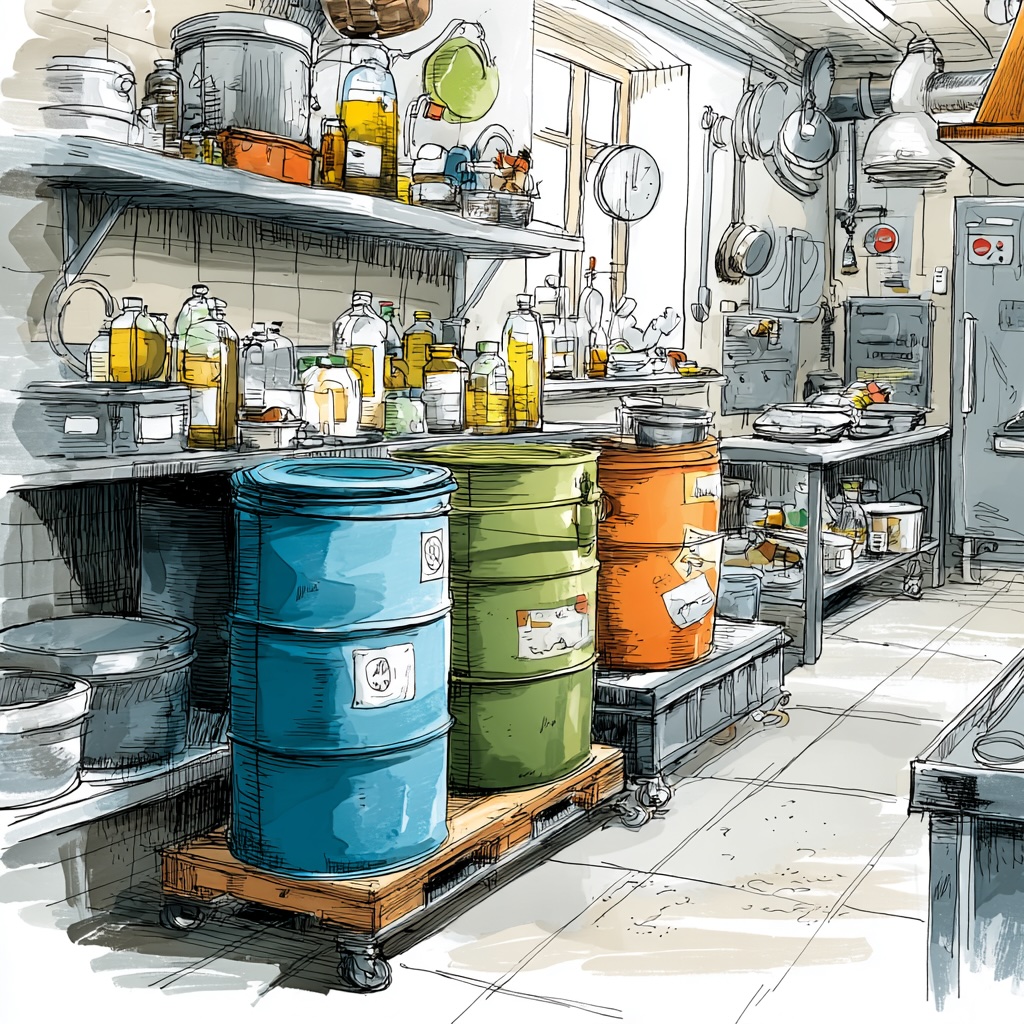
The most common outdoor commercial used cooking oil containers are steel drums and rectangular steel tanks, ranging from roughly 55 gallons at the low end to 240 or 300 gallons for high-volume operations. Steel is the standard material for outdoor containers because it handles temperature extremes, resists impact damage, and doesn't degrade under UV exposure the way some plastics do over time. Outdoor steel containers designed for UCO collection feature locking lids, splash-control grates at the fill opening, and sloped or sealed bases that prevent standing water from accumulating around the container.
Outdoor containers in the 55 to 100 gallon range work well for smaller restaurants with one or two fryers that change oil weekly. Operations with three or more fryers or higher-frequency oil changes should look at the 200 to 300 gallon range to avoid overflow between scheduled service visits. Hotels, commissaries, and high-volume food production facilities in Queens and Brooklyn often operate containers at the larger end of this range, with service scheduled weekly or biweekly depending on output.
Matching Container Size to Your Kitchen's Volume
Sizing is where most operators either get it right immediately or spend the first few months adjusting. The core calculation is simple: how much oil does your kitchen cycle through per week, and how often will the container be serviced? The container needs to hold at least that weekly volume with some margin for a missed or delayed pickup. Getting that calculation wrong in the undersized direction means overflow events. Getting it wrong in the oversized direction means oil sitting in the container too long, which creates degradation and odor problems.
A practical starting point by operation type looks like this:
-
Single fryer, low-volume kitchen (neighborhood café, small bakery, deli): 35 to 55 gallon container, weekly or biweekly service
-
Two to three fryers, moderate volume (casual dining, fast-casual, pub): 55 to 100 gallon container, weekly service
-
Three or more fryers, high volume (full-service restaurant, fried-food-focused concepts, ghost kitchen facilities): 150 to 275 gallon container, weekly or twice-weekly service
-
Multi-fryer institutional kitchens (hotel food and beverage, hospital cafeteria, large commissary): 275 gallons and above, or enclosed bulk systems with direct-connection plumbing
These are starting points, not formulas. How quickly your trap fills also depends on what you're frying. Breaded and battered proteins break oil down faster and increase the total volume of waste oil generated per gallon of fresh oil used. Knowing how often your fryer oil actually needs to be changed is the key input to getting your container sizing right, because the two decisions are directly connected.
Security, Labeling, and NYC Compliance Requirements
In New York City, container compliance isn't just about the physical equipment. It's also about how that equipment is labeled, secured, and documented. The DEP's Best Management Practices, codified under 15 RCNY Section 19-11, require that yellow grease containers be secured against theft. That requirement exists because a stolen container creates a gap in your documentation chain: if oil leaves your premises without a licensed hauler providing written proof of collection, you're out of compliance regardless of why. NYC DEP regulations specifically state that it is the generating establishment's responsibility to secure their yellow grease so that proper written proof of collection can be obtained every time.
In practical terms, this means outdoor containers should have locking lids that can't be easily accessed without a key or proprietary connection fitting. Containers provided by licensed UCO collection companies typically come with security features built in. Indoor containers are inherently more secure by virtue of being inside a locked building, but they still need to be clearly labeled as used cooking oil storage and kept separate from all other waste streams, including grease trap waste.
Labeling matters during DEP inspections. An unmarked container, or one positioned in a way that suggests mixed waste streams, is a compliance flag even if the oil inside is clean and properly handled. Keeping your yellow grease clearly separated from brown grease from your grease trap is not just good practice, it's a regulatory requirement, and your containers are where that separation either happens or doesn't.
Grease theft is a real problem across NYC's outer boroughs in particular, and Queens and Brooklyn operations with outdoor containers have seen recurring incidents. Beyond the security hardware on the container itself, placement matters. Containers positioned in visible, lit areas near service entrances with foot traffic are significantly less likely to be targeted than isolated containers in dark alleys or low-traffic loading areas. If you experience a theft, document it immediately so that the gap in your collection records can be explained and supported.
Who Provides the Container and Who Owns It
In New York City, the standard arrangement is that your licensed UCO collection provider supplies the container as part of the service program, at no charge to you. This is how our program at Bio Energy Development works. We can deliver and maintains it over the course of our service relationship. Plus it comes with the documentation required to demonstrate compliance. Using an improvised container, a container purchased independently, or a vessel not rated for used cooking oil creates complications both operationally and during inspections.
Proper storage conditions start with the right container and extend to how and where you transfer oil before it reaches that container. The full chain from fryer to collection point is worth thinking through as a system, not a set of disconnected steps.
Conclusion: The Right Container Sets the Foundation
A commercial used cooking oil container isn't just a vessel. It's the starting point for your entire compliance and collection program. The right container, correctly sized, properly placed, and appropriately secured, means your oil is handled safely, your pickups run smoothly, and your documentation holds up during a DEP inspection. In a New York City kitchen, where space and operational constraints are real, getting these decisions right from the start matters more than adjusting after problems appear.
At Bio Energy NYC, we provide free, commercial-grade containers to every operation we serve and work with you to find the right size and placement for your specific kitchen layout. To get started, explore our used cooking oil collection and disposal service or our grease trap cleaning program. When you're ready to get set up, contact us or request your free pickup today.
Bio Energy Development is a BIC-licensed, DEC-permitted used cooking oil collection and grease trap cleaning company serving Manhattan, Brooklyn, and Queens. BIC Lic. #TW3525 | DEC Permit #1A-1149 | EPA ID #NYR000170753.