How Does a Grease Trap Work? A Clear NYC Guide
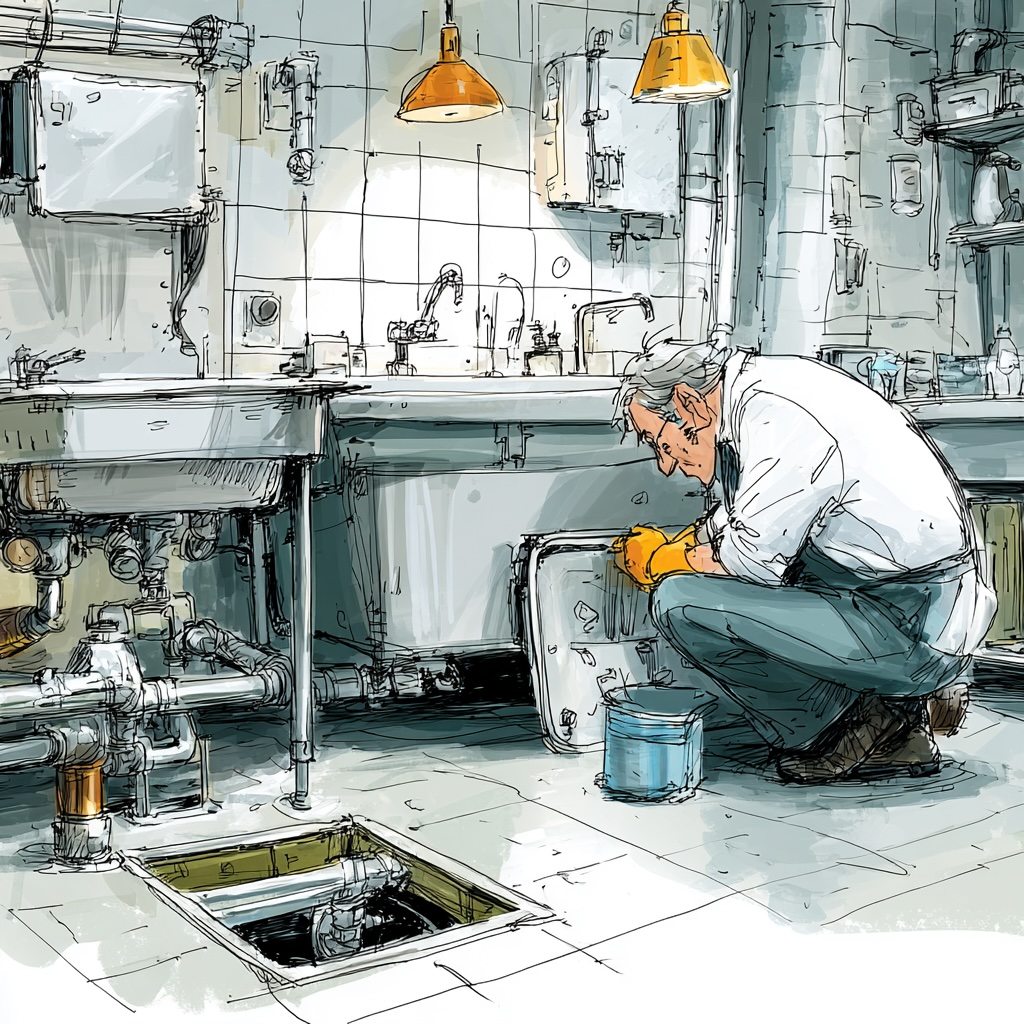
If you've been told you need a grease trap, had one installed, and still aren't entirely sure what it does or why it matters, you're not alone. Most operators treat their grease trap as something that exists in the background of their kitchen operations, requiring service occasionally, and best not thought about too closely. That's a reasonable attitude when things are working. It becomes a problem when something goes wrong and you don't understand why.
We clean grease traps for food service operations across Manhattan, Brooklyn, and Queens, and the questions we hear most often come from operators who want to actually understand the system, not just have someone maintain it for them. This article gives you a clear, practical explanation of how a grease trap works, the physics behind it, the types used in NYC kitchens, and what happens when one is neglected.
Why Kitchens Produce Grease That the Sewer Cannot Handle
Every commercial kitchen that cooks, fries, sautés, or prepares food sends wastewater down the drain that contains fats, oils, and grease, collectively called FOG. This is unavoidable. Residual grease from pans and pots, the film left on dishes after a meal service, the runoff from wok stations and griddles, and the fat particles suspended in dishwasher water all enter your drain lines as part of normal kitchen operation.
The problem is what that FOG does once it cools. Fats and greases that are liquid and flowing at cooking temperatures begin to solidify as the water cools down inside the pipes. Over time, this solidified material accumulates in drain lines, building up in layers along pipe walls and eventually forming blockages. When enough of this material reaches the municipal sewer system, it combines with other organic waste, compounds, and materials to form what are commonly called fatbergs: dense, concrete-like masses that can block entire sewer lines and cost the city millions of dollars to remove.
New York City's sewer infrastructure, aging and already under pressure from the density of the city, is particularly vulnerable to grease blockages. The DEP estimates that a significant share of the city's sewer backups are grease-related. This is the reason grease traps are not optional for food service operations in NYC. They are a legal requirement under the NYC Plumbing Code and enforced by the Department of Environmental Protection. Understanding the full compliance landscape around grease and used cooking oil in New York City is the context that makes the grease trap's role easier to understand.
The Core Mechanism: How Grease Traps Separate FOG from Water
A grease trap works by exploiting a basic physical principle: grease is less dense than water, so it floats. Given enough time and a slowed flow rate, the FOG in your wastewater will naturally rise to the surface, while heavier food particles and solids will sink to the bottom. The relatively clean water in between can then exit through an outlet pipe into the municipal sewer.
The trap achieves this through several design features working together. Wastewater from your sinks, dishwashers, floor drains, and cooking equipment enters through an inlet pipe. Inside the trap, a flow control device or baffle slows the incoming water down significantly. This reduced flow rate is what gives the separation process time to work: at the fast flow rate of normal pipe drainage, the grease doesn't have time to rise and separate before it's already past the outlet. Slowing the flow gives the FOG time to do what physics wants it to do anyway.
As the wastewater slows and cools inside the trap chamber, the grease and fat rise to form a floating layer at the top. Food solids and sediment heavier than water sink and settle at the bottom. The middle layer, which is the clearest water, is what gets drawn off through the outlet pipe. Baffles inside the trap create a physical barrier that prevents the floating grease layer from being pushed out through the outlet even when more wastewater enters. Most commercial traps also include a vented air space above the grease layer, which prevents pressure buildup from forcing material through the outlet.
Types of Grease Traps Used in NYC Commercial Kitchens
Not all grease traps are built the same, and the type installed in your kitchen depends on your kitchen's size, layout, available space, and the volume of grease-laden wastewater you generate. NYC presents particular constraints because kitchens are often small, access is limited, and installation options are shaped by what's structurally feasible in older buildings.
Hydromechanical grease interceptors (HGIs) are compact units typically installed close to the point of use, either under a three-compartment sink or adjacent to a dishwasher. They work through the passive separation process described above and are practical for smaller-to-moderate volume operations where interior space is the primary constraint. These are common in Manhattan restaurants where underground or outdoor installation is not practical. Gravity grease interceptors are large-capacity tanks, often 500 to 2,000 gallons, typically installed underground outside the building or in a building's basement. They have much greater grease and solids retention capacity, require less frequent servicing for the same volume of wastewater, and are better suited to high-volume operations. Brooklyn commissaries, hotel food and beverage facilities, and large institutional kitchens in Queens often use gravity interceptors. Because they require a retention time of approximately 30 minutes for full FOG separation, they are appropriately sized for high-flow applications where a smaller unit would overflow quickly. Automatic grease removal devices (AGRDs) are also an option that adds a motorized skimming mechanism to the passive separation process. These units automatically remove the accumulated grease layer at timed intervals into a separate collection container, reducing the frequency of manual pump-outs. They are better suited to operations where space is extremely limited or where access for regular servicing is complicated. NYC buildings with tight basement configurations or complex access requirements sometimes use AGRDs precisely because they reduce the logistical burden of periodic cleaning.
The 25 Percent Rule
The grease trap works as long as the accumulated FOG and solids don't exceed the trap's functional capacity. As the floating grease layer builds up and the settled solids layer grows from the bottom, the effective working volume of the trap shrinks. When the combined depth of grease at the top and solids at the bottom reaches approximately 25 percent of the trap's total liquid depth, the trap is no longer able to function as designed. FOG begins bypassing the baffle system and passing through the outlet into the sewer.
This is the basis of the 25 percent rule, which is codified directly into New York City's DEP regulations under 15 RCNY Section 19-11. The regulation states that grease interceptors must be cleaned as frequently as necessary to prevent the accumulated fats, oils, grease, and solids from exceeding 25 percent of the total liquid depth the device was designed to hold. That's the legal standard, not a general recommendation. Exceeding it puts you out of compliance.
In practice, the 25 percent threshold translates to different cleaning intervals depending on your trap's size and your kitchen's volume. A well-sized trap in a moderate-volume kitchen might reach 25 percent in 60 to 90 days. A trap that is undersized for the volume it's handling, or a kitchen running at higher-than-expected capacity, might reach that threshold in a matter of weeks. How often your kitchen generates oil and FOG is directly tied to how often your trap needs service, and the two systems are worth thinking about together.
What Happens When a Grease Trap Is Neglected
A grease trap that goes too long without cleaning doesn't fail quietly. The first signs are usually slow drainage, since the accumulated solids partially block water flow through the trap. Foul odors follow, caused by the rancid grease and decomposing organic material sitting in the trap under kitchen temperatures. If not addressed, the trap eventually reaches a point where FOG bypasses the baffles entirely and enters the sewer, which is both an environmental violation and the thing the trap was installed to prevent.
Beyond the drain backup and odor problems, a neglected grease trap is a DEP compliance violation. The Department of Environmental Protection conducts inspections and can issue fines of up to $10,000 per violation. A trap that is overflowing, improperly maintained, or documented as not cleaned at appropriate intervals represents exactly the kind of finding inspectors are looking for. The documentation requirement is also important: cleaning records must be maintained on-site and available for review during an inspection. A trap that has been cleaned but has no paper trail behind it still creates compliance exposure.
Keeping your grease trap documentation current and accessible alongside your used cooking oil records is part of how a well-run operation demonstrates compliance across both FOG management streams during a DEP visit.
The Connection Between Your Grease Trap and Your Yellow Grease Container
One point of confusion we frequently encounter is the relationship between the grease trap and the used cooking oil collection container. They are two different systems handling two different waste streams, and they cannot be substituted for one another or combined.
Your grease trap collects brown grease: the FOG that enters your drain lines through normal kitchen washing, floor cleaning, and dishwashing operations. This material is mixed with water, food solids, and organic sediment. It is denser, more contaminated, and chemically different from fryer oil. It must be removed by a licensed hauler and is not recyclable into the same clean fuel pathways as yellow grease.
Your used cooking oil container collects yellow grease: the relatively clean oil that comes directly out of your fryers and cooking equipment. This is the material that goes into biodiesel and other recycling pathways. It must be kept separate from grease trap waste, stored in a sealed container, and collected by a BIC-licensed hauler with written proof of collection every time. Mixing the two streams creates a contaminated material that is harder to handle, disrupts the documentation chain for each waste stream, and creates compliance problems for both. What a grease trap does and where the distinction between brown and yellow grease matters becomes clear once you understand both systems as separate but complementary parts of your FOG management program.
Understanding Your Grease Trap Makes It Easier to Maintain
A grease trap is not a complex device, but it does require consistent attention and a clear understanding of what you're maintaining and why. The physics that make it work, density separation and gravity, are simple. The compliance requirements that surround it are real and enforceable. The consequences of neglecting it range from drain backups and kitchen odors to $10,000 DEP fines.
At Bio Energy NYC, we provide professional grease trap cleaning to food service operations across Manhattan, Brooklyn, and Queens, along with used cooking oil collection to keep both FOG streams properly managed and documented. When you're ready to get your grease program on a solid footing, contact us or request your free pickup and we will take it from there.
Bio Energy Development is a BIC-licensed, DEC-permitted used cooking oil collection and grease trap cleaning company serving Manhattan, Brooklyn, and Queens. BIC Lic. #TW3525 | DEC Permit #1A-1149 | EPA ID #NYR000170753.